Showing posts with label Cannes Film Festival. Show all posts

Tuesday, 26 February 2013

[Review] To The Wonder - A Valediction: For Whispering

To The Wonder (2013)

Director - Terrence Malick
Country - USA, France
Starring - Ben Affleck, Olga Kurylenko, Amy McAdams and Javier Bardem
Running Time - 112 minutes
SynopsisAfter visiting Mont Saint-Michel, Marina and Neil come to Oklahoma, where problems arise. Marina meets a priest and fellow exile, who is struggling with his vocation, while Neil renews his ties with a childhood friend, Jane.

Filmmaker turned philosopher Terrence Malick has never had what one would define as a consistent production output. Between his debut Badlands in 1973 and 2005s The New World he released just four films (with a twenty year gap in there as well.) Yet, against his character, just over a year after the critically acclaimed Palme D'or winner The Tree of Life was released, his newest film To The Wonder arrives in cinemas this week. 

Since Days of Heaven (1978) Malick's films have increasingly been geared away from conventional narrative and towards existential musings on faith, love and nature. This style built towards the grandiose The Tree of Life which charted the beginning of time itself to the end of existence through the point of view of a child growing up in 1950s Texas. Though majestically constructed and cinematically important, it wasn't a perfect film, the height of which was a horrifically misguided sequence involving  dinosaurs that would be dropped from a Land Before Time sequel. Though it was the ambition of his sentiments that firmly secured it as a fascinatingly flawed masterpiece. For me, it was the summation of these elements that should have marked the end (or at least a break) of this movement in his career.

Instead, To The Wonder sees Malick push further into poetic montage, presenting us with a story of crisis, one of love and one of faith... that is to say love and faith, as Malick conditions it. 

The film opens with what would go down in history as the most artistically shot phone camera footage as lovers Neil (Ben Affleck) and Marina (Olga Kurylenko) travel across France. Malick is known for his beautiful 35mm canvas-like compositions, so this opening is a way of playing with his established style just as to invite the audience into making personal associations with the grainy intimacy of iPhone visuals. Still, I found it hard to take seriously as an expression of smitten playfulness when Affleck is busy lining up his shots to the rule of thirds. Their voyage through France is presented with as much restraint as an over-excited Nikon advert. The graceful rolls and tilts of the camera as he moves into and passed the lovers become an extension of passions that the audience cannot share in, they feel removed and even naive. He constantly looks to the sky for answers, but is more frequently met with the loneliness of a plane cutting through the sky, as a motif it feels unwarranted and coincidental, brought in through in the editing suite as a vague way of capturing interest.

Europe ends and when Neil invites Marina and her ten year old daughter to come live with them on a housing development in Oklahoma. They spend their time frolicking gleefully through fields, curtains and supermarkets, when their relationship comes under strain the two strut round the house in silence, as if on isolated planes of existence. All the while Kurylenko's ethereal voice over rambles aimlessly about the nature of their love and her own discontent. To put it bluntly, this constitutes so much of the film that it crosses into unintended self parody. Increasingly Malick's characters have become less a defined person in their own right and more a channel for his own existential concerns, here they lack any form of identity at all. There is so little progression, development or narrative exposition that any profound point on the nature of relationships and love Malick is trying to capture is totally lost as the character's become figures, shifting weightlessly between passions, continents and partners.  
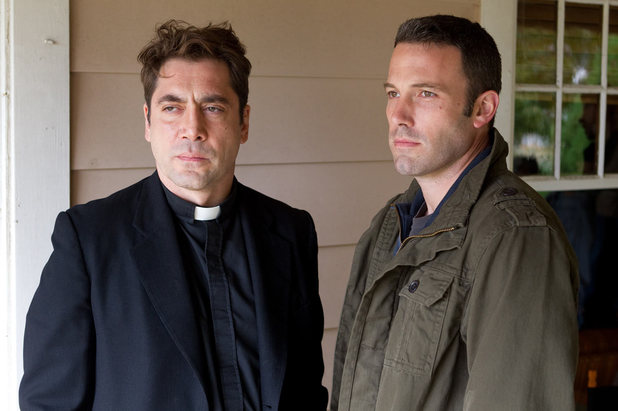
Just as The Tree of Life was led by a reflective, autobiographical tone, To The Wonder feels like a personal confession manifesting itself as a convoluted experiment, Malick splits himself between two male figures; Affleck's Neil and Bardem's Father Quintana. The former is a man struggling with committing to, and defining himself within, his relationships. He offers Marina warmth, affection and support but cannot give himself completely to her, and when her Visa expires he refuses to marry her resulting in her deportation. His attentions then turn to childhood friend Jane (Rachel McAdams) in a brief middle section that fails to offer any supporting weight to the narrative. Quintana is a community priest who's relationship with God has been strained due to the economic and social disintegration of his neighbourhood. In an interesting move Malick moves to a Neo-Realist style as Bardem moves from house to house interacting with local residents. Although the more engaging of the two, Malick fails to unite the narratives other than a few shots of Marina and Quintana together. As a result the methodical lines plucked from his sermons lack any significance with Neil and Marina's story and his resolution unmoving. Even worse, as Malick begins to indulge in scenes with drug addicts and the disabled the film moves past earnestness and into crass exploitation. 

Undoubtedly Olga Kurylenko is the central character of the piece, with Malick himself regarding it as 'her film.' His camera leans into her sensuality, capturing the curve of her neck and the elegance in her movements to the extent it borders on voyeurism. This is made all the apparent by his total disregard for Amy McAdams who is presented more flatly and distanced. In a strange scene, Malick drowns out her back story with Marina's voice over, illustrating his lack of interest in Jane's character. Yet despite this focus, she is still is nothing more than an ideal, a representation of love that Malick can only grasp at, but not retain.

In my research on the film I was enlightened to know that those invited to the Press Screenings of To The Wonder were given notes on the characters, time frames and pollution subplots which is all but brushed aside in favor of the overly enigmatic mess we are left with. Given the films problematic production with actors dropping out, characters being removed completely and shooting beginning without a finished script, it becomes clear that this is a shell of Malick's intended vision. To an extent it excuses the lack of substantial structure to the narrative, but none the less, To the Wonder is still an indulgent and overblown exercise in tedium. The whispered spiritualist romanticism's of his script fail to amount to any tangible thoughts on the fervent desires and illusions of love nor faith and therefore feels obnoxiously preachy.

2/5

Sunday, 11 November 2012

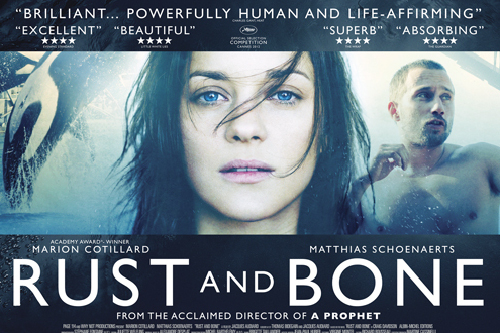
Rust and Bone - All sticks and stones


Put in charge of his young son, Ali leaves Belgium for Antibes to live with his sister and her husband as a family. Ali's bond with Stephanie, a killer whale trainer, grows deeper after Stephanie suffers a horrible accident. 

'I'm OP' replies the man blankly as he stares at the woman across the table when she questions their sexual relationship. He is Ali, she is Stephanie, 'Op' is their code word for hooking up. Both are marked by scars, physically and emotionally, but it was those scars that brought them together, now it threatens to shift them apart. Bones may break, rust may show, but wounds can heal, such is the tone for Audiard's nuanced drama about the human condition. 

Jacques Audiard has been considered by some a new-generation Dardenne for his previous films A Prophet and The Beat that My Heart Skipped. Although I see the connection, I feel it is a little misjudged. Where the brothers flatten their images, removing expression in the sytle of Bresson. Here Audiard basks his in sun-baked light and natural colours that reminisce of a more gentle Scorsese, almost to the point of indulgence. Ali's underground bare knuckle boxing fight may be suitably grimy and unflinchingly violent, but it's captured with a grace one would attribute to... Oh say... Orca whales gliding through the ocean with a elegant, unstoppable power. The connection is intentional, Ali is himself an Orca - capable of great damage but houses a capacity for gentleness. He struggles to process his emotions, but is also practical, kind and in ways remarkable, but he distances himself because of what he can do. His lover Stephanie carries the scars of one Orca, for Ali it is all-to-great of a reminder. 


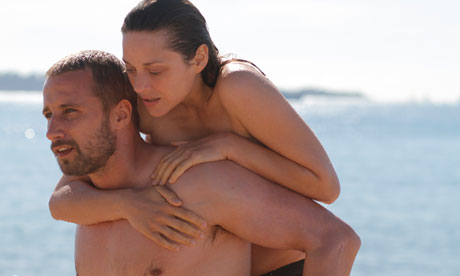
Rust and Bone is, first and foremost, a performance piece. Marion Cotillard is remarkable as a woman who has been stripped of her life. In a conversation between the two she admits to enjoying being watched, going to nightclubs in order to entice the eyes of men, now she is reduced to a cripple gawked at by bathers on the beach. The film is light on emotional outbursts, save for one devastating scene where she wakes up in hospital only to discover her legs have been amputated, but it is through her movements and gestures, her posture and expressions that she sells her character's depression before gradual acceptance and reintegration into life. By contrast, Matthias Schoenaerts' Ali is a man of unapologetic physicality. He inhabits most of the frame, cutting through each shot with force and unpredictability. Yet, as he demonstrates in a scene in which he carries Stephanie into the ocean for a much needed, liberating swim, he is capable of a cumbersome gentleness. Both are worthy of the inevitable Oscar nomination they will, or at least should, receive. 

The film is carried by these fragile interactions between the two. One such example would be when Stephanie accepts Ali's offer of sex, 'to see if it still works,' she removes her tights, timidly at first before unraveling to unveil a sensuality that she so previously exuded. Through the intimate camera and the low key ambiance of the soundtrack we not simply observe but feel the subdued passions that slowly overwhelm first Stephanie then eventually Ali.  


Unfortunately Audiard's drama doesn't match his character's restraint, skating around and occasionally dipping into the realm of implausibility it creates an uneasy level of inconsistency. Early on, in a bid to feed his hungry son, Ali is shown stealing a from an electronics shop. It is only a few hours later they are picked up by his sisters husband and taken to a house and fed. A rather rash, unjustified action all things considered. The son isn't really given enough attention to warrant his existence in the first place, instead he serves as a device to illustrate Ali's emotional distance and fearsome destruction and Stephanie's relationship. The most contrived sequence comes during one of the bear knuckle fight sequences as a battered Ali looks down for the count until Stephanie shows up and inspires him to victory, not so much a moment of euphoria as a rejected scene from a Rocky sequel. To frequently does Audiard give way to melodrama this way, and ultimately the film's impact suffers. 

There is a minor potency here that is much admired, but it is wrapped in a somewhat misguided screenplay, resulting in a noble miss-fire. Audiard's direction is assured undoubtedly, but it is through the performances from Cotillard and Schoenaerts that we eventually give ourselves to the films tenderness. Like it's characters, the movie succeeds, wounded and bruised, but with bones (and rust) intact. 

3/5

Saturday, 27 October 2012

[Review] Beasts of the Southern Wild - Magic or Trickery?


Faced with both her hot-tempered father's fading health and melting ice-caps that flood her ramshackle bayou community and unleash ancient aurochs, six-year-old Hushpuppy must learn the ways of courage and love.

As someone who is fairly up to speed with the cinematic world, it can prove an almost impossible task to approach a film completely subjectively. Especially when it is lauded with the amount of critical appraisal and pre-award season hype that Beasts of the Southern Wild has befallen on. Being the cynic I am, I was suspicious of the buzz. A landmark debut, coming-of-age, modern fairy-tale celebrating a naturalist existence in the bayou. That description alone is enough to get most critics gushing. And indeed the bayou does hold a distinct magic that has given birth to some of America's most beloved classics. However it was only when I caught a glimpse of the trailer that the warning lights set off like Blackpool pleasure beach. It looks like a Nikon advert, I remarked to those who had too been intrigued by the hype, and that is essentially what Beasts is. A manufactured snap shot of freedom. Bathtub is director Benh Zeitlin's smug attempt at creating his utopia, but it is merely the idea that he is in love with.

In the opening sequence our protagonist Hushpuppy, played by Quvenzhané Wallis, creeps around her garden listening to the heartbeat of the animals, 'Everything's heart is beatin' and squirtin and talkin' to things in ways I can't understand.' I groaned. It's the kind of narration one would here from a Terrence Malick parody. But Zeitlin plays it with a straight face; including a number of sequences were Hushpuppy talks to her long-gone mother. You see, where Malick's hushed verse acts with restraint, coming from a deep seated existentialism, Zeitlin indulges in it frequently to underscore the film with a 'feel the world' tone. I call it bullshit.


Wallis is a pin-up for the film's message and every scene is bookended by shots of her staring stonily into the distance, less an expression the ferocity she meets each of her problems with, and more an excuse for the poorly structured narrative. Her performance is one of texture, she is surrounded by mud, rust and earth and she inhabits the role well, acting and reacting to the ever changing environment around her. However the tendency to spit her dialogue at the audience tends to undo that. Regardless, she's positively masterful compared to her father played by Dwight Henry who chews up the scenery and almost descends into racial stereotyping as opposed to acute naturalism I imagine Zeitlin thought he was writing. This is only enhanced by film's claustrophobic and 'natural' cinematography, which is, frankly terrible. Director of photography Ben Richardson has a lot to answer for here as even the simplest of conversations and actions become a nauseating, infuriating mess.

It is a shame, because the thing I liked most was its setting, which despite Zeitlin's best efforts, remains endlessly fascinating. That says more about the landscape's natural wonder as opposed to the set design, which is so heavily cluttered, literally including the kitchen sink on more than one occasion. Still I will admit to marvelling at the flooded Bathtub or twilight river brothel that channels late Kieslowski. But these are merely aesthetics, the clunky social commentary and celebration of earthly life that are tied to them do nothing for me. Remember the astonishing river sequence from Charles Laughton's The Night of the Hunter; a sequence hung in the balance between unnatural stillness and a hopeful calm. It was a scene, that through its twilight induced imagery embodied the film's prayer for the safety of children through a tough and unforgiving world. Yeah, the equivalent moment here is Hushpuppy's remark 'It wasn't no time to sit around crying like a bunch of pussies.'

At a mere 93 minutes long, Beasts is not given enough room to develop its characters or world, the drama and set pieces feeling rather inconsequential. Much of the interaction between Hushpuppy and her father are heavy-handed attempts to illustrate their growth and development, rather than letting them develop through their actions. The town of Bathtub is essentially a testament to Zeitlin's limitation. It is the eco-friendly life of self-expressive naturalism that can only come from someone raised on the outside looking in. Zeitlin himself was born and raised in Queens, New York city but relocated to New Orleans in 2008 to shoot his short film Glory at Sea. Bathtub is his heaven, but his observations of such a life are so unintuitive that we cannot sympathize with the actions of its inhabitants. Celebrate self-reliance, sure, but when that self-reliance turns to stubborn arrogance and eventually to straight up suicide, it leaves you wondering, why spend the whole time celebrating such an existence if you're not going to survive to experience it? The film's final metaphor comes in the form of the Aurochs, an ancient beast woken from slumber by the melting ice caps. More than a simple carbon-foot-commentary, they are an embodiment of all that threatens to offset Hushpuppy's survival, and she will have to meet it with force. A convincing metaphor it would be, if the monster looked somewhat convincing. As it is, it looks like someone stuck cardboard horns on a boar.  

 
Beasts of the Southern Wild is the type of film that is prone to a critical backlash, but I'm sure that won't weather Hushpuppy's spirits much, I imagine she'd care little for any analysis or deconstruction of her world in any way. But Zeitlin is not as immune as his six year old heroine, and it is only a matter of time till he and his earthy creation are found wanting. Critics and audiences have bought into the world of Bathtub, but soon they will realise that it is just a festival of light and moonshine, shying away from the truth and hardship of life on America's most idyllic highway.

2/5