Saturday, 15 December 2012

Absolute Cinema - Bigger than Life

Absolute Cinema is a continuing series of moments that I illustrate a moment of cinematic transcendence. These can be a single element or a variety of cinematic techniques that come together in such a way that elevates cinema. It might be an entire sequence or just a particular shot, edit, score it doesn't even have to be on purpose. It is a moment exclusive to cinema as an art form.

[Entry 5] Absolute Cinema: Bigger Than Life


In The Name of the Father


In his operatic melodrama Bigger than Life, director Nicholas Ray breaks down and reverses many of the nuclear family ideals, James Mason plays Ed Avery, a middle class school teacher who is diagnosed with a potentially fatal disease and given the new miracle drug cortisone as a means of suppressing its progression. Treatment becomes dependency, and it is not long before dependency becomes addiction, turning Avery into an egotistical maniac and something much more disturbing.

Ray's paternal issues spilled into his film making. His films are themselves 'bigger than life,' visuals of pure personal emotion. His decision to shoot a domestic drama on CinemaScope is inspired genius giving Avery warped sense of grandeur, contained within a tightly structured setting. The real victim here, as with much of Ray's work is son Richie who finds himself at the brunt of his father’s increasing instability. Avery becomes a twisted representation of traditional American values - religion, education and family. Psychologically bullying his son before Ray delivers a moment of fierce, twisted intensity.

At a time when boys looked to their fathers for reassurance and safety from the monsters on their TV, from the escalating Red-scare. Ray is formidable as he casts his image, deeply coded in Expressionism. For Richie, there was no comfort to be found with his father. As Avery looms over his son, his shadow contorts into a warped figure of Elvis and then into a beast, arched on all fours. He becomes the monster from the TV. It is the most direct image from Ray's canon, and one of the most daring shots of 50s American cinema.

[Review] The Hobbit: An Unexpected Journey - Long in the foot

The Hobbit: An Unexpected Journey (2012)

Director - Peter Jackson
Country - USA, New Zealand
Starring - Martin Freeman, Ian McKellen and Richard Armitage
Running Time - 169 minutes

A curious Hobbit, Bilbo Baggins, journeys to the Lonely Mountain with a vigorous group of Dwarves to reclaim a treasure stolen from them by the dragon Smaug. 

As the world rapidly uploads itself to the digital space, there is a sense that the cinema has come full circle. A machine art form for the machine age, when it began in the late 19th century people immediately recognized its potential to take us to the world unseen. We could travel to every part of the globe through a make-shift theatre set up in the back of a gymnasium. Now it is the computer screen that draws the minds of millions every day. With it, the cinema has moved towards the digital. By that I do not mean the rise of digital cameras and projectors, but the landscape itself. For the first time, and with a sizeable enough budget, film makers can capture the magic not just of our own world, but of any one imagined complete with lens flare and digital gloss through a recliner chair in an office building.

Perhaps there is no finer moment to illustrate this evolution than when Ian McKellen's Gandalf looks down at a young Bilbo Baggins and states with a distinct lack of irony; 'The real world is not in your books, it's out there.' 

The reason that Jackson's Ring trilogy was such a defining moment in cinema was because of how tangible it was. He drew on the beauty of New Zealand's landscape and a balance between practical and computer effects to create a world that was both believable and fantastical. With the advancements of CGI even since the end of The Return of the King, Jackson is able to create a much more expressive Middle-Earth for prequel The Hobbit. The landscape is more vibrant, the miniature ('bigatures') sets are replaced with digital ones and every mildly recognizable British TV actor gets a fake nose. Unfortunately with this reliance on computer effects, the authenticity has gone. You no longer feel Middle Earth as a real world, but a product of digital conception, expertly crafted but a product none the less. One could argue that this is a younger, more innocent Middle Earth that has not been tainted with the destructive allegorical evil of the Ring trilogy yet and therefore the more colourful look is suited, indeed Tolkien's book is a more child-aimed affair. However Jackson draws attention to its connection with Rings, coupled with some of the darker side elements and the result is that The Hobbit has a rather uneven tone and visual disconnection.

This is very much a prequel to the trilogy and an older Bilbo, initially played by Ian Holm, pops up to tie the two together. Make no mistake, although Frodo appears, this is Bilbo's story. There's a terrific shot early on that cements this as Frodo steps out of Bag End, a wide shot shows a hobbit in the distance striding through the landscape, walking stick in hand. Before panning out to reveal Frodo enthusiastically check the mail box for invitation responses, with it, the baton has been handed back so speak. There is a freedom to this journey due to the lack of 'the one ring' (at least in a significant sense) and Martin Freeman isn't quite the wet blanket that Elijah Wood was. Watching him gradually slide, or more appropriately, trip into the role of unlikely hero is very natural. His courageous, yet rash actions and errors in judgement give away his inexperience, and Freeman shrinks into the role, frequently letting the others take over the action, but his moment will come in due time.

The band of Dwarves that make up the group offer up plenty of entertaining interactions and riffs, even though you'll really only remember the names of about five. There is an uneasy feeling that hangs over this film that their quest just isn't that interesting. This feeling is shared most of all by Jackson who includes a variety of subplots, including an intriguing incident involving the rumoured emergence of a necromancer, which I imagine will be handled in the sequel to come. It is as if the movie is unsure of itself and looking to over compensate, it leaves itself rather bloated.

At nearly three hours long, it has to be said that it is just too long. The opening half hour amounts to nothing more than descriptions of cutlery and sing-alongs. The pace gradually increases as the film progresses, but it is constantly being interrupted by establishing shots, flashbacks and, of course, the arbitrary trip to Rivendell for which critic Bob Chipman rightly describes as 'The High Council of Exposition.' Make no mistake, once we leave the Shire this isn't a slow film, it's very busy and littered with action, even to a fault. Some have been written in, some are smaller scale skirmishes that have been expanded to full scale battles; they tick the boxes for sensational excitement, but end up feeling quite repetitive and contrived. The worst of which involves the mountain our heroes are traversing becoming a giant stone monster itself, which might be the most overt artificial lengthening sequence I've ever seen. The real highlight is undeniably Bilbo and Gollum's game of riddles, which despite being intense and darkly funny, only enhances the feeling that this is a step down from that series. 

Much has been made of the 48 frames per second format; I for one cannot comment on how it looks yet, defiantly I went with the 24-2D version. I am planning on seeing it for comparison, but impressions I've heard have ranged from apathetic to bad. Really I don't see this being the next step for cinema as Jackson intended and I wonder how much more complicated things will get for the average movie goer.

There is some excellent film making here, flashes of the brilliance that made Jackson's Lord of the Rings a classic of epic storytelling, but The Hobbit: An Unexpected Journey is too bloated, too indulgent and simply just not as interesting. It has neither the impact, nor organic design of its predecessors, and one cannot help but make the comparison. At least now that the characters and set up has been properly established, the next instalments will be a complete return to form. As it is however, you cannot help but wonder how co-writer Del Toro's would compare. A shadow has been cast over Middle Earth, but it is one made up of code and pixels, it looms towards us, a warning of this new cinema at a speed of 48 (or 24) frames per second.

3/5


Monday, 10 December 2012

[Review] Sightseers - The Caravan Condition

Sightseers (2012)

Director - Ben Wheatley
Country - United Kingdom
Starring - Alice Lowe, Steve Oram
Running time - 88 minutes

Synopsis - Chris wants to show girlfriend Tina his world, but events soon conspire against the couple and their dream caravan holiday takes a very wrong turn.


Britain as a society is one built upon its traditions, and perhaps none is more ludicrous (or cherished) than that of the sacred caravan tour from campsite to campsite, complete with an abundance of vexatious locals and washed out skies. Led, marketed and even defended by a safe middle class sense of freedom that allows one to enjoy the hospitality of the great outdoors filtered through rusty showers, pull-out beds and deck chairs. Not to mention the immense strain on our mental well-being that comes with being confined to sailor-esque quarters with our nearest and dearest. For Ben Wheatley the caravan tradition masks something much more disturbing lurking beneath the surface of our mud-stained paradise. 

There is a direct primal quality to Wheatley's films, one scarcely engaged or even referenced in Britain or indeed British cinema since the 1970s. However he engages with it head on, tapping into our most visceral urges through aggressive slow-motion close-ups dominated by his male leads. More sinister however are the various cults and rituals that take place up and down the country, in last years Kill List it was the ultimate expression of middle class denial, here it infests our characters psyches and brings them into a hypnotic, violent trance. Murder is perhaps the most natural and basest means of expression.

Drawing on a legacy of lovers-on-the-run films, Sightseers' takes notes from Natural Born Killers, Mike Leigh's Nuts in May and one very obvious visual nod to Terrence Malick's debut Badlands. The message here may not be remotely original, but through the jet black realism humor, audaciously straight soundtrack and increasing absurdity of Chris and Tina's blood-stained 'erotic odyssey' the film amounts to more than the sum of it's influences. 
 
Too easily could this descend into a crass exploitation of our customary ideals at the expense of some cherished British quirks. However, neither writers Lowe or Oram, nor Wheatley are looking to mock. Instead, they find a great deal of admiration and beauty within their locales as Chris and Tina stare slack-jawed at the world’s largest pencil in the Keswick Pencil Museum or dance in the reflected light of the Blue John Caverns in Derbyshire. However there is an intense haze that blankets the landscape, inhabiting the Lake District in an alien yellow or unsettling mist, it spills into the attractions. The retired trains of Crich Tramway Museum become industrial skeletons, slapped with the label of 'heritage' as if to install a sense of entitlement and responsibility into those who come to stare. Something which Chris adopts instantaneously, or so it appears in his satisfied smile as he backs over an indignant litter bug with his caravan. This is when things change.


It is not Chris' vigilant desire to protect British tourist attractions that drives him to, as Tina puts it 'murder innocent people,' but a deeply seated social resentment. After all when he is confronted by an angry member of the National Trust after dog Poppy fouls an ancient site of interest, Chris brutally murders him, justifying it with 'He's not a person, he's a Daily Mail reader.' As the body count racks up, Tina slowly emerges as the more dominate of the two, much to Chris' discontent. Murder may be the most natural means of expression, but it is his means, and having his girlfriend take matters into her own hands usurps his control. The aforementioned jet black humor has taken the stage here, but it comes with an unnerving sense of guilt and discomfort that comes from each gloriously gooey murder. Unfortunately this wears the film down, and it runs out steam shortly before redeeming itself with an astonishing finale.        

Perhaps it isn't the fault of Chris and Tina for the disastrous outcome of their holiday, but a result social and economic climate of which they are a product, an unsettled, tainted generation who find themselves constrained by an obligation to fix the world. Led by Wheatley’s assured direction and two career-making performances, their tragedy becomes giddy pop-enjoyment, twisted thrills and a surprisingly sombre romantic charm. Eventually, as with most Holidays, Sightseers’ overcomes its issues through the tinted eyes of post-viewing reflection. You might not be after an 'erotic odyssey' of your own anytime soon, but the British countryside has never housed a more mysterious and lurid beauty.  

4/5


Friday, 30 November 2012

The Melting-pot: The Docks of New York

Because this site is in dire need of new content, and because reviews of Amour and Sightseers are a few days off, here is a piece I wrote as a presentation for class. Though it has given me an idea for a series, that I may revisit in the coming weeks.

The Character of New York City in Joseph Von Sternberg's masterpiece The Docks of New York.


The use of setting can be vital in reinforcing or enhancing a film’s narrative. It can be a source of an infinite amount of ideas and details that can help tell a story move vividly, in many regards, if used appropriately the setting can become a key character itself. In this way the city of New York has had a long standing relationship with film beginning as early as 1908 with The Thieving Hand moving through to 1928’s The Jazz Singer which, released in the same week, eclipsed Sternberg’s movie. But The Docks of New York represents an important development in such a tradition; it shifts the action to the compact New York harbor, buzzing with atmospheric chaos to disguise harsh realities, it is a working-class love story for the city’s waterfront.

Here director Josef von Sternberg utilizes the city backdrop as a key role in the blue-collar romance between stoker Bill Roberts and wounded ‘good-time-girl’ Mae. Much more than a setting, it becomes a pivotal character and perhaps an omnipotent entity in the story through Sternberg’s set design, mise-en-scene and cinematography.

New York is a 20th Century Gomorra, a melting pot of differing culture, class, religion and race. Much of the story takes place in the local bar, Sternberg compacts people together, with little room to breath. This creates an atmosphere of uncertain intensity, dangers do lie in the docks inhabitants; rapists, thieves and murderers - and the crowded set design often takes queues from Dicken’s London enhancing the immorality but also isolating the docks, allowing them to have a structure of their own being. Sternberg rarely frames his actors with a static background. More often than not the party rages around them, as New York does not stop for the actions of few. This allows the brief moments of stillness shared between the characters to become more intimate. The people of New York bubble with a destructive vitality. Docks is also an observed social commentary, as dances and skirmishes make up the nights entertainment, as an outlet for it’s inhabitants own personal anguish. There is little distinguish their dancing with the random bursts of violence, their movements are filled with a harsh rhythm and weighted gestures. They are hive mind, acting without independent thought and moving in mass towards each spectacle. Note the wedding sequence in which all spectators and witnesses raise their hand in mock protest or flock to the scene of the murder when Andy is shot by his wife Lou. But these are moments of induced euphoria brought upon by the spell cast by the harbor’s thick fog. And it is through this audacious night, that this tough, realistic romance becomes an honest and delicate contrast.

Sternberg’s waterfront is more than just a player, it is a manipulator. It not only observes everything, but is itself everything. It’s stage is laid out how it see’s fit, the people involved become it’s performers. We can attest to this with how we witness Mae’s attempted suicide; a reflection in the water - it is the city who entices not only Mae but us the viewers as well. Another reflection comes in the form of the two supporting characters Andy and Lou, who mimic Mae and Bill not just physically, but also emotionally, they are not just a reflection of things that (could) come, but a warning sent by the city to be heeded. One can not help but feel that our character’s hands have been guided slightly as the harbor’s design unfolds to their needs. Here the city becomes... not so much reflective of the characters, but actively partaking in their story. The fog that settles over the dockside softens lights and hides edges. It becomes a hazily romantic as Mae and Bill look out over the lock. The simple bedroom the two share at night is the blank slate that the two needed. However when morning comes Sternberg shoots it with a harsh light, exposing the cracks, outside New York’s humdrum of activity has been reduced to the murmur of manual labor, the romanticized fog has now been replaced with the black smoke from a ships funnel, as if the city itself has turned its’ attention away from our characters and back to the mundane, cruel realities of life.

We are but a witness in one night of New York here, these people do not exist for us, but for themselves and the city. Bill and Mae’s story is just one of many thousands. This is presented so perfectly in the film’s final shot, as the camera pulls back through the courtroom and our two protagonists stand frozen together for just a moment, meanwhile the next case begins around them. Sternberg’s New York will not allow us to hear their story, not this time, and it pushes us out to the exit and the film draws to a close.

The Docks of New York is a film about people, that just so happens to star a city. Sternberg utilizes a lot of cinematic techniques in order to personify the city, such as it’s free flowing choreography, the mass of people who populate the area as the cities life force. Or the directed and compact layout that give a sense of a living entity, one that has the ability to change it’s own image for the needs of the players. And with his camera, which traverses the docks searching delicate beauty amongst the harsh reality, only to linger on it for a moment. It is a world of chaos, perhaps even lost in time. A world that would have it’s own role to play in the stories of everyone who would come to pass there. 

Monday, 26 November 2012

[Review] The Master - Unlocking the Past


A Naval veteran arrives home from war unsettled and uncertain of his future - until he is tantalized by The Cause and its charismatic leader.

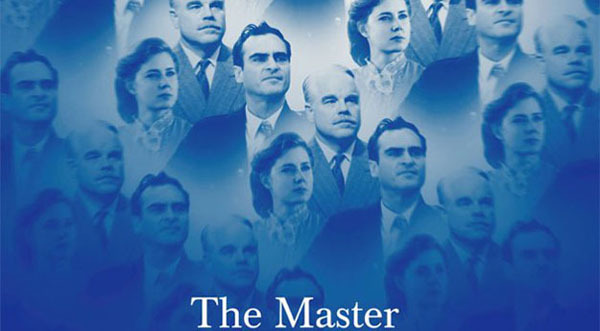
Paul Thomas Anderson's The Master is perplexing, mesmerizing, maddening and quite possibly genius. A cerebral film that refuses to be categorized, analyzed or defined, it is, at it's heart, a love story between two post-Freud, post-war figures of the American man. 

The first of which is Freddie Quell, he is a man of impulse and instinct. We meet him at the close of World War Two where he is stationed off the coast of Japan. It is here that the primal charge that dominates his actions is most befitted, a life of unrestricted physicality. Yet underneath his edged masculinity lies deep psychological scarring; would he, driven by a subconscious urge, cut off his hand as he batters coconuts for their milk, just to see how it bleeds? Or, as he fingers the cast of a woman made from sand he conceals a violence through a pretend laughter, but the give away is in his eye. Freddie is not simply a case of 'not ready for society' but a reversal, society is the one who is not ready for him. Perhaps twenty years later in the late 1960s would his volition be more accepted. However it is condition that the scientists and society do not understand yet. To them he is, among many others, evidence of a dark failure within America's triumph. One the country can not acknowledge in a post-war recovery period, so they are given their place, and they must adjust. Drunk on his self-brewed moonshine, Freddie cannot find his place, and after accidentally poisoning his friend, he rejects it.

How exactly he finds himself on the pier that would begin his relationship with Phillip Seymour Hoffman's Lancaster Dodd is left ambiguous by Anderson. Perhaps it was Dodd that was drawn to him. His borrowed cruise ship looms into focus, presenting itself to Freddie and the world as a figure of American wealth and of the opportunist. It sails into the blue black night, party a blaze and flag at full mast.  


On board, and after an implied night of boozing, Freddie is introduced to Dodd, who recognizes a skewered sense of liberation buried within his impulsive actions and scars. He adopts him into the ranks of his scientific religious movement, The Cause. Dodd is equal parts romanticist and charlatan, he recognized the potential in the post-war atmosphere for a new market of self-fulfillment through pop-psychology and spiritualism, only to find himself trapped by a group of followers who take his ideas more seriously than he ever did, spurred on by a cold and domineering wife played by a ferocious Amy Adams, her performance has been overlooked but is equally phenomenal. To Dodd, Freddie is something of an oasis, and in return he looks to cure him through his methods, even though it becomes apparent that Freddie is beyond their help and even stands to be a danger to himself and his movement as well. 

The film has received much attention for it's parallels between The Cause and the Church of Scientology which emerged at the same time, with Dodd being the stand in for L. Ron Hubbard. What the movement actually does isn't particularly important, and Anderson is often to keen to expose the holes of Dodd's persona. To hastily does he resort to the child like 'Pig fuck!' when confronted by simple skepticism. However this is not a deconstruction or criticism of the Scientology, but an examination of who it targeted and what drove people to it.

Anderson's work is struck by the recurring theme of surrogate fatherhood, here it is a product of Freudian subconscious. Freddie's psychological issues stem from his abandonment of his father and incestuous relationship with his Aunt. This led to the self-fulfillment failure of the relationship with his muse, Dorris. And in one sequence Dodd becomes a figure of Oedipal resentment as he dances with the women of his congregation, for Freddie the women are naked and overlooking him for the father. Dodd's methods of 'processing' are primitive, bordering on a form of psychological torment as he systematically insists Freddie repeat a test from the beginning everytime he blinks. Gradually however his answers become more engaged. He produces just enough evidence for one to begin to believe. 


Shot on the cinematic holy grail 65mm and presented in 70mm at the Odeon, West End, Anderson's film is surprisingly light on the grandiose scale that the format is usually reserved for, it has its more elaborate visual moments, but the real key here is his close-ups and focus. He captures every detail of the face. Nuanced expressions, twitches of subconscious trapped beneath the surface bubble to the top as Phoenix's right eye quivers. Shot on an extremely shallow depth of field, people and objects fade in and out of focus creating a spatially constrictive environment that centers on the actions of the actors, allowing them to inhabit the world with a sense of unhinged grandeur. The score is the work of Radiohead's Jonny Greenwood who uses disjointed chords and nervous rhythms to offset the drama and creating a fractured tension, an effect which he used to similar effect on Anderson's previous film There Will Be Blood

Lacking any semblance of narrative structure, the film is driven by relationship between it's two thoroughly unlikable, but rather tragic heroes. The result is Anderson's least accessible, but perhaps his greatest film. 

The two meet for the last time in England, and as Freddie rejects Dodd's last attempt to pull him beneath his wing, the two react within accordance to themselves; Dodd softly serenades him, trying to part with bloated grace but barely concealing an anger spawned by his adopted son and protege's ultimate defiance. Freddie reverts to a more primal urge and picks up a girl in a local pub. He toyingly samples her on some 'processing' of his own, is this a subversion or a regression, it is left ambiguous. The film ends by revisiting the image of Freddie caressing the woman in the sand, a past life, left but not forgotten. Like wise, it is Anderson who is staring back into a damaged era, searching for the answers to our own, instead he finds a pattern woven into the human condition over a millennium; the sins of the master have been passed down to the subject, from one charlatan to the next.
 

5/5


Sunday, 11 November 2012

Rust and Bone - All sticks and stones


Put in charge of his young son, Ali leaves Belgium for Antibes to live with his sister and her husband as a family. Ali's bond with Stephanie, a killer whale trainer, grows deeper after Stephanie suffers a horrible accident. 

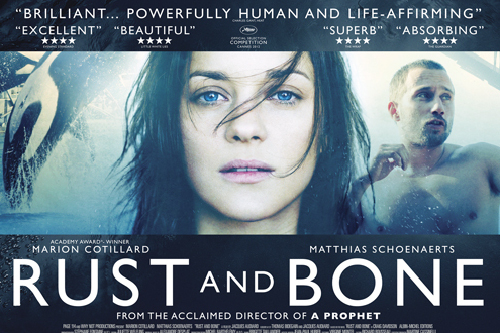
'I'm OP' replies the man blankly as he stares at the woman across the table when she questions their sexual relationship. He is Ali, she is Stephanie, 'Op' is their code word for hooking up. Both are marked by scars, physically and emotionally, but it was those scars that brought them together, now it threatens to shift them apart. Bones may break, rust may show, but wounds can heal, such is the tone for Audiard's nuanced drama about the human condition. 

Jacques Audiard has been considered by some a new-generation Dardenne for his previous films A Prophet and The Beat that My Heart Skipped. Although I see the connection, I feel it is a little misjudged. Where the brothers flatten their images, removing expression in the sytle of Bresson. Here Audiard basks his in sun-baked light and natural colours that reminisce of a more gentle Scorsese, almost to the point of indulgence. Ali's underground bare knuckle boxing fight may be suitably grimy and unflinchingly violent, but it's captured with a grace one would attribute to... Oh say... Orca whales gliding through the ocean with a elegant, unstoppable power. The connection is intentional, Ali is himself an Orca - capable of great damage but houses a capacity for gentleness. He struggles to process his emotions, but is also practical, kind and in ways remarkable, but he distances himself because of what he can do. His lover Stephanie carries the scars of one Orca, for Ali it is all-to-great of a reminder. 


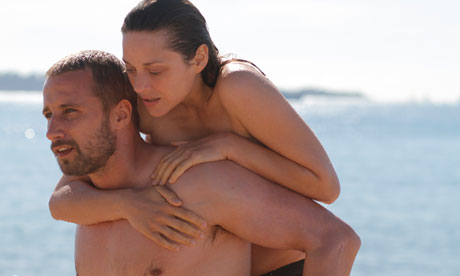
Rust and Bone is, first and foremost, a performance piece. Marion Cotillard is remarkable as a woman who has been stripped of her life. In a conversation between the two she admits to enjoying being watched, going to nightclubs in order to entice the eyes of men, now she is reduced to a cripple gawked at by bathers on the beach. The film is light on emotional outbursts, save for one devastating scene where she wakes up in hospital only to discover her legs have been amputated, but it is through her movements and gestures, her posture and expressions that she sells her character's depression before gradual acceptance and reintegration into life. By contrast, Matthias Schoenaerts' Ali is a man of unapologetic physicality. He inhabits most of the frame, cutting through each shot with force and unpredictability. Yet, as he demonstrates in a scene in which he carries Stephanie into the ocean for a much needed, liberating swim, he is capable of a cumbersome gentleness. Both are worthy of the inevitable Oscar nomination they will, or at least should, receive. 

The film is carried by these fragile interactions between the two. One such example would be when Stephanie accepts Ali's offer of sex, 'to see if it still works,' she removes her tights, timidly at first before unraveling to unveil a sensuality that she so previously exuded. Through the intimate camera and the low key ambiance of the soundtrack we not simply observe but feel the subdued passions that slowly overwhelm first Stephanie then eventually Ali.  


Unfortunately Audiard's drama doesn't match his character's restraint, skating around and occasionally dipping into the realm of implausibility it creates an uneasy level of inconsistency. Early on, in a bid to feed his hungry son, Ali is shown stealing a from an electronics shop. It is only a few hours later they are picked up by his sisters husband and taken to a house and fed. A rather rash, unjustified action all things considered. The son isn't really given enough attention to warrant his existence in the first place, instead he serves as a device to illustrate Ali's emotional distance and fearsome destruction and Stephanie's relationship. The most contrived sequence comes during one of the bear knuckle fight sequences as a battered Ali looks down for the count until Stephanie shows up and inspires him to victory, not so much a moment of euphoria as a rejected scene from a Rocky sequel. To frequently does Audiard give way to melodrama this way, and ultimately the film's impact suffers. 

There is a minor potency here that is much admired, but it is wrapped in a somewhat misguided screenplay, resulting in a noble miss-fire. Audiard's direction is assured undoubtedly, but it is through the performances from Cotillard and Schoenaerts that we eventually give ourselves to the films tenderness. Like it's characters, the movie succeeds, wounded and bruised, but with bones (and rust) intact. 

3/5

Friday, 9 November 2012

[Review] Silent Hill 3D Revelation - and some news!


When her father disappears, Heather Mason is drawn into a strange and terrifying alternate reality that holds answers to the horrific nightmares that have plagued her since childhood.

The video-game movie genre is always something that has baffled me. On a basic level, why should I want to watch something that I would probably have more fun actually playing. More-so however it strips the medium from it's unique perspective on narrative. Video-game storytelling has come a long way from 'Save the Princess' or 'Shoot the aliens' and the Silent Hill series is arguably the best example of this development. A game should intertwine game-play and narrative (much like a film should tell its story through cinematic language,) - allowing the player and his actions to effect the events of the story. With Silent Hill, basic game design becomes an extension of the character's psychological state and the games thematic message. Enemies are not a means of obstructing progress, they are a twisted manifestation of the characters fears and desires. Decaying locals are more than mere tactics to unnerve, they are a template for an oppressive, omnipotent entity. 'Examining' certain objects will trigger different emotional responses which will effect the outcome of the story. Whilst many games have choices, often as simple as 'good' or 'bad', very few integrate as organically as Silent Hill

The reason for this bloated introduction, the reason I'm telling you this, is to prepare you for my frustrations in the review to come. As a game, Silent Hill is the pinnacle of (and forgive me for using this term, but that's a different debate altogether) - one art form. This adaption however, is the lowest of another. 


In the pre-title 'haunted fairground nightmare' sequence in 'Revelation' director Michael J. Bassett demonstrates his refined approach to cranking up atmosphere and tension with a dead goldfish sinking to the bottom of it's bowl, hitting the bottom with a might thud. As ridiculous as that sounds... it's undercut even further when you realize fish rise when they die. This is the madness that is Silent Hill.

So, the story picks up from the first one, which is a problem right away, you see unlike the Resident Evil adaptions which are virtually on annual release now, the first Silent Hill was released six years ago, and nobody cared enough to remember what happened, least not the writers who introduce a Deus Ex Machina along with a brief cameo for Radha Mitchell to fill in some gaps. She, rightly so, can't get out of town fast enough as she runs off into the gloomy fog via a mirror leaving Sean Bean's Christopher behind. The film is based, loosely, on the third Silent Hill game which is a successor to the first (the second being a standalone title.) By 'based' I mean it uses some basic plot elements and some iconic costumes for the characters, but that's more or less where any similarity ends.

Adeliane Clemens (who looks surprisingly like a younger Michelle Williams) plays Heather (or Sharon or Alessa she was known last time around) who is constantly moving because her father once stabbed a man in self defense. She starts a new school, knowing that it is only a few weeks before the whole process starts over again, a point she hammers home in a completely needless monologue in front of the whole class, channeling Bella Swan in excess. Within minutes Heather is hallucinating or day dreaming, it's never really explained nor is the delusional screaming girl even noticed by anyone around her. Except for Vincent, a shoe horned and rushed love interest, who may or may not (but most definitely is) hiding something played by Kit Harington. Neither manage to generate any feeling for their characters, but I feel this is an issue with the script more than actors. Wasting much more experience talent in Sean Bean's father. He's completely and utterly useless, just as he was in the first film. Even more bizarre is the cameo from Malcolm McDowell who hams it up so hard he projects himself into a six foot monster, it's perhaps the most amusing part of the film and worth looking up on Youtube.

Taking it's talk of ancient evil and demonic cults far to seriously, Bassett (who also wrote the screenplay) fails to impart any sense of foreboding. His lack of restraint with the pacing sidelines development and atmosphere for cheap scares that have little to no effect. Monsters come with so little build up and are dispatched with so easily that you begin to question what threat this 'hell' really poses. A problem only intensified by the film's poor structure, characters spring up from a 'convenient nowhere' to spout some convoluted expository babble before we're raced along to the next set piece, leaving us with very little investment in whats going on.
The games were designed to oppressively wear down the player, toying with them psychologically using sound design and imagery, while the pace escalated slowly through the game. The soundtrack, which the game's are also renowned for, were made up of industrial ambiance with melancholic piano and guitar riffs punctuating the horror with sombre, haunting hopelessness. Here, they grate incessantly out of place, all else is forgettable. The imagery is a crass attempt at grossing out the audience with icky effects, reducing the games Rosemary's Baby inspired theme of motherhood and rebirth to mere shock tactics. The 3D manages only to disguise the cheap sets from further embarrassment and it even lacks the predictable gimmicks that could have resulted in some low brow thrills. 

The lowest point comes from series icon Pyramid Head, for the uniniated that would be the big guy on the poster with the... pyramid shaped head. Once a visceral and terrifying manifestation of a protagonist's violent and sexual urges, here he jumps to the rescue of our main characters to battle it out in a goofy 'final boss' style showdown. A baffling transformation that draws up comparison to Godzilla's reversal from destroyer to protector in the 60s.
    
Silent Hill Revelation 3D is a pointless, thrill-less ride through inconsequential gooey nonsense. It's infuriating disregard for the source material makes me wonder who this film is actually for; not the fans who are likely to pick it apart as I have, and I struggle to find a reason the public would connect with this, especially when there are much better horror offerings on at the moment, and that includes Paranormal Activity 4. No, this is a film in search of a quick buck from anyone it can entice down the rabbit hole with promises of madness and twisted scares, but they have been mislead, the only evil here is the uncaring money grubbers who rushed this out the door in time for Halloween. Heed the warning, don't go to Silent Hill.   

1/5

----------------------------------------------------------------------------------------------------------------------------

[An Update:]

I know content has been rather sparse on here for the last two weeks, and unfortunately that will probably continue for a number of weeks. As any other university student will let you know, work has a tendency to hit you all at once and as I type this to you now there is a niggle thought in my head to drag myself back to the books. Still I have plans for some good content on this site, including a retrospective on some older, undervalued science fiction films from an era gone by. As well as a continuation of the Absolute Cinema series among other things, but this leads me into my news...

I am now the Film Correspondent to the Arts section of the Yorkshire Times website (link). This opportunity came through a friend and is a chance I didn't think I'd see for a long time. Film criticism is something I've wanted to do for the best part of my life and to get such a jump so early on is practically a dream come true. 

So be sure to check there over the coming weeks for my reviews and articles, as well as some of the other fantastic pieces on there that are well worth your time.