Showing posts with label Horror film. Show all posts

Friday, 12 April 2013

[The 13th Belfast Film Festival] Day 1 - The Mask


And so it begins. 

This is the first entry in my coverage of the 13th Annual Belfast Film Festival. Over the course of the next 10 days I've booked myself into a lot of films, and I hope to find time to cover them all for you. This is something I'm pretty excited about, the range and quality of the films on show over the course of the festival is an example of how Belfast has developed both culturally and cinematically over the last couple of years. 

I kicked off the festival in the cosy bean-bag cinema, a snug and suitably low-key setting that fitted the vibe of our first film perfectly. 

The Mask (1961) 

Location - BFF Beanbag Cinema

Director - Julian Roffman
Country - Canada, USA
Starring - Paul Stevens, Claudette Nevins, Bill Walker, Anne Collings
Running Time - 83 Minutes
Synopsis - A young archaeologist believes he is cursed by a mask that causes him to have weird nightmares and possibly to murder. Before committing suicide, he mails the mask to his psychiatrist, Dr. Barnes, who is soon plunged into the nightmare world of the mask.

As 3D tears its way through our multiplexes with an unsupported metabolism, each new re-release and shoe-horned gimmick come with the sense of inevitable collapse. The profits are down, the release numbers are down and the interest is down. Why? There is probably a long list of socio-economic factors that could be wheeled out in order to explain the short lived fad. Yet it is in the view of this film-school romantic that 3D is losing its numbers because its lost its fun

And here we have Julian Roffman's low budget horror-schlock The Mask which doesn't just gives us all the gimmicks and silliness, it embraces them in a wonderful meta-textual exploration of audience interactivity. 

Just as The Wizard of Oz famously opened in Black and White, before blowing the world apart in a Technicolor marvel, The Mask traps us in the two dimensional reality as the suicide of a young archaeologist launches a inquiry about a missing mask. For the first half hour the film plays out like one part Scooby Doo, one part Citizen Kane. Slowly the pieces unravel as detective and psychologist move from clue to clue but it is only when the missing mask (mailed before the archaeologist could take his own life) arrives Dr Allan Barnes desk (in a moment of pure Hitchcockian McGuffunry) that things enter the new dimensional horror promised by the films trailer. 

Tempted by the enclosed letter, Barnes dawns the mask and is immediately inflicted with horrific visions. Put on the mask! Put on the mask! Put on the mask! Rings the voice over, but really it's a warning to the audience. On goes the old school red and blue glasses and suddenly we all found ourselves in a grotesque trans-dimensional nightmare. How well these sections worked almost took me by surprise, structurally they're pretty flimsy, the don't really offer anything other than haunted house sequences intended to shock the audience with vague ties to the overarching story of ancient evil. Yet I couldn't help but give myself to them completely. It brought the audience along with Dr Barnes into a new reality, giving the effects a reason to exist and the audience a reason to interact with them. Not to mention the sequences themselves were marked by creatively devilish set design and special effects, it frequently called to mind the work of Jean Cocteau, had he collaborated with Goya. 

The Mask might be a little to dreary for it's own good, there isn't enough ham to make it's rather silly and forgettable plot all that interesting, and the acting isn't great, but it isn't terrible enough to offer up more than a few giggles. But that didn't stop it from being a joyously memorable ride on an old rickety ghost train.


Saturday, 9 March 2013

[Review] Stoker - The Family Blood

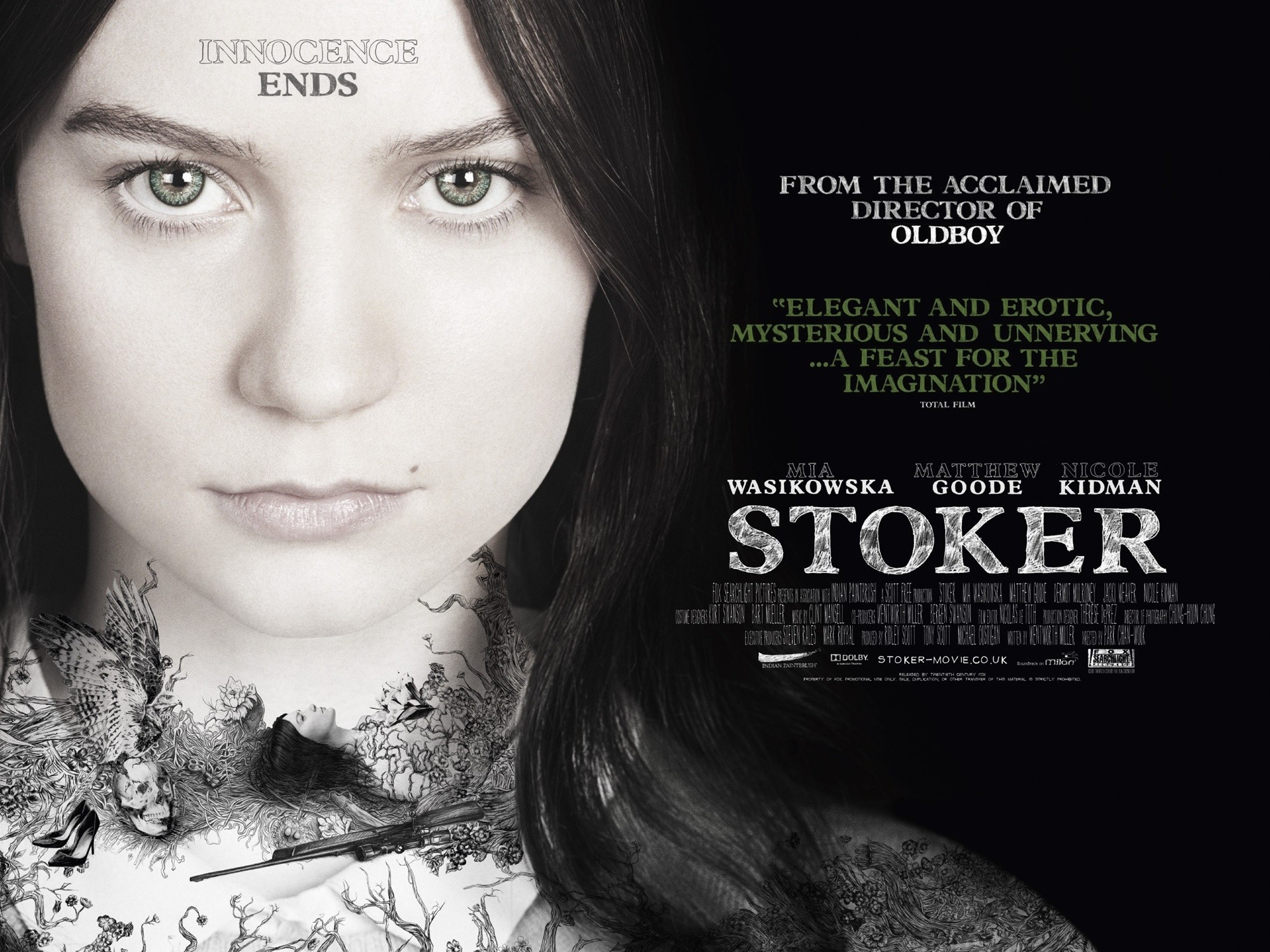
Stoker (2013) 

Director - Park Chan-wook
Country - South Korea, USA
Starring - Mia Wasikowska, Matthew Goode, Nicole Kidman
Running Time - 98 Minutes
Synopsis - After India's father dies, her Uncle Charlie, who she never knew existed, comes to live with her and her unstable mother. She comes to suspect this mysterious, charming man has ulterior motives and becomes increasingly infatuated with him.

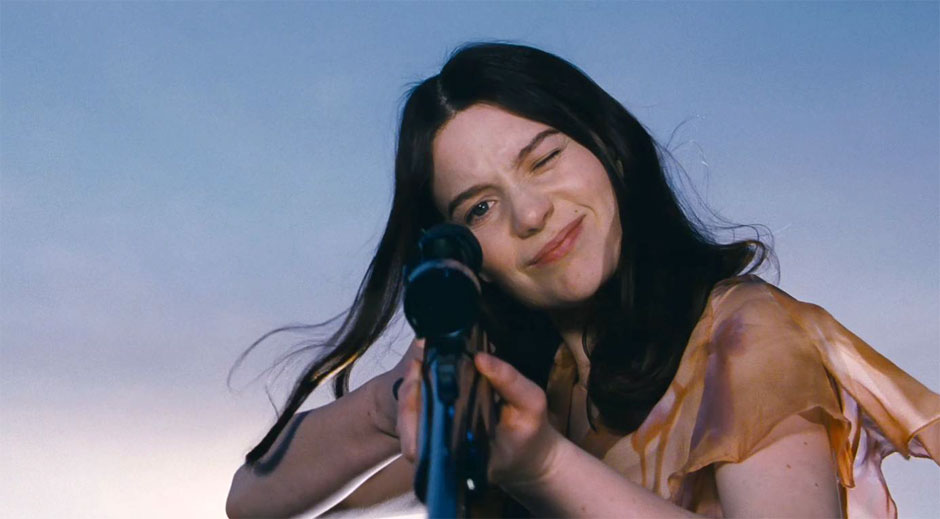
Throughout his career, Korean director Park Chan-wook's films have each been centered on a single punctuated moment, a scene in which his protagonists come to a moment of pure, cataclysmic awakening. Often sexual, often violent, more often both - it represents an ultimate realization in the world Park Chan-wook belongs to, a point of no return at the loss of innocence and humanity itself, he gives his characters no choice but to give themselves to it. It is in the crazed eyes of Dae-su Oh when his nemesis twists the knife in one last time, or in the reinvigorated, reborn Sang-hyun, a Catholic priest turned vampire who finds himself enslaved by his desires. In his first English language film, Stoker, it is the soapy hands of Mia Wasikowska and never before has it been so rapturous, so alluring.

India is a girl who can 'see and hear what others cannot' whether that is a spider inching itself up the back of her leg, or the ominous presence of the uncle she didn't know she had, lurking on a nearby hill at her father's funeral. Soon after her mother announces that Charlie (as he is known) will be coming to stay with them triggering a series of disappearances and pushing the not-so-concealed matriarchal narcissistic envy to fever pitch.


Written by Prison Break actor Wentworth Miller, Stoker was named on the 2010 Black List, a list consisting of the top unproduced scripts circulating Hollywood before it eventually found itself in the hands of Park Chan-wook. The director, best known for a series of films dubbed The Vengeance Trilogy certainly brings a visceral theatricality the films proceedings. Regular collaborator Chung-hoon Chung adds an unparalleled vampirish tone to the pastoral coloured walls in the Stoker household. Soft lighting, canted compositions and frayed movements distinguish the film with a degree of 'modern-gothicism.' An IKEA based form of expressionism, where twisted sets and heightened shadows have been replaced by the muted furnishings of the flat-pack. Though, like the ritual family dinner it is really all a surface facade. Just as their formal suggestions of post dinner entertainment and passing remarks about ice cream swirls mask ulterior motives and paternal resentment, the block colours and grand rooms give way to the cobwebbed and decaying basement (where, naturally, the aforementioned ice cream is kept.)

Sex and violence is what Park Chan-wook belongs too, as two sides of the same coin. For India, the girl with a fear of being touched, her growing attraction to Charlie thrusts her into a psychotic, twisted form of womanhood. The film moves into a state of male paranoia, as the female sexual awakening represents something much more dangerous. This doesn't so much seep into the films design, as it is soaked in it. Stoker is made of a direct, symbolic flamboyance that calls to mind the likes of Brian De Palma. De-leaded pencils dripping in blood, an abundance of sultry close-ups and a heightened creaking sound design deliver a thunderously charged atmosphere. 

Though the main influence is none other than Alfred Hitchcock, borrowing heavily from his 1943 film ,Shadow of a Doubt. François Truffaut once said that the Master of Suspense shot murder like a love scene, and a love scene like a murder - the same can be said for Park Chan-wook. But where Hitchcock had to skate round censors, here it has an abrasiveness that has carried over from Park Chan-wook's routes. This is made most obvious in an explicit shower masturbation scene, where the once cleansing act has been reversed into a surrendering to our primal desire. Thankfully the excellent, off-kilter yet quirk-free performance from Mia Wasikowska gives India the unsettling edge needed to back up the distanced and tested mother played by Nicole Kidman. Rounding out the performances are a surprisingly tongue-tied Jackie Weaver and a twinkly-eyed, soft spoken Matthew Goode who will no doubt be soaring to the top of every casting list for the next big Vampire flick.  

For all its artistically sculpted crafting, Stoker never manages to light the spark it sets. Miller's screenplay is too hinged on implausibility and one tell-all and ultimately underwhelming flashback. We are left waiting for that final twist of the knife that never comes. Instead, we get the creak of a belt, the aim of a scope and a splatter of blood too easily cleaned from the muted tones on which they plastered.

3/5 


Thursday, 28 February 2013

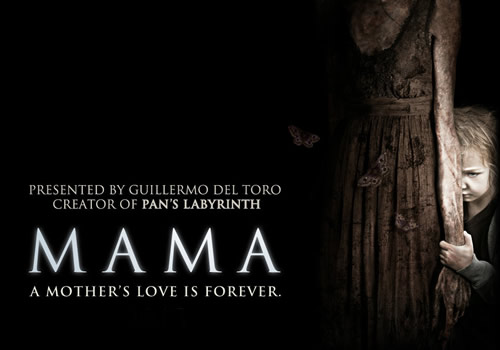
[Review] Mama - Domesticated Demon

Mama (2013)

Director - Andrés Muschietti 
Country - USA
Starring - Jessica Chastain, Daniel Kash and Nikolaj Coster-Waldau
Running Time - 100 minutes
Synopsis - Annabel and Lucas are faced with the challenge of raising his young nieces that were left alone in the forest for 5 years.... but how alone were they? 

The notion of motherhood is one that has lent itself completely to horror down through history. The bond between mother and child is derived from such an intense physicality that the unyielding devotion and intimacy is so easily reversed and fractured. Through nature alone maternal relationships have a degree of specific psychological conditions; envy, overbearing narcissism and reflective anxieties that are ripe for the picking for any budding screenwriter. The surrogate mother removes this physicality, replacing it with more external and social factors that also been prayed upon in the horror genre. Look to Jack Clayton's 1961 cinematic translation of Henry James' Turn of the Screw, The Innocents, a ghost story created from sexual frustrations and hyper active custodial psychosis. It implemented these factors into the Freudian qualities of the set design, the harshness of its high-key lighting and the manic performance by Deborah Kerr to give us an atmosphere of psychological-frenzy, in other words, it's an intelligent ghost story born out of step-parent anxieties.

Now in 2013 we have Mama, by Andrés Muschietti, where any symbolism and psycho-analysis has been replaced with deathly clumps of hair and evil wallpaper.

Since her breakout performance Jessica Chastain has become signified with the role of the mother figure, most obviously in Terrence Malick's The Tree of Life where she became the manifestation of grace. Her face houses a calming naturalism and unquantifiable homeliness. Something that she managed to shed completely in the critically acclaimed Zero Dark Thirty, a film that highlights the unique force of the maternal instinct by it's total absence. Mia as she is known in that film, feels incomplete as a human because she has no family. So Mama then should feel like an extension of her cinematic undertakings thus far. She plays Annabel, a tattooed guitarist in a rock band hastily thrust into the role of a parent without ample preparation when her boyfriend's nieces show up five years after their homicidal father kidnapped them.

Chastain's jet black fringe and Misfits T-shirt fail to convince as she awkwardly strums a bass guitar whilst chugging down a bottle of Becks. Yet, as the burdened and disinterested carer she slips into the role pretty confidently, as if a reversal of her character in The Tree of Life - spending less time frolicking in the garden and more time pacing around the house, half-assedly doing menial chores. The film successfully rejects the formulaic responses of modern suburban horror films such as the Paranormal Activity series in which the light of day casts out the nightly bumps and the world returns to normal. Domestication is the real horror here as Annabel suddenly finds herself having to contend with snooping Aunts and accident prone kids. Chastain looks legitimately uneasy preparing dinners or loading the washing machine, and the lifeless cinematography does nothing but further our restlessness.

Inevitably, as one would expect when adopting forest dwelling children, creepiness befalls the household in the predictable fashion of monster closets and flickering lights. Not to outdo it's contemporaries for too long, it borrows a couple of floating blanket scares that no longer unite the audience through a chorus of 'Ohs' and 'Ahs.' Still, Mama has a number of tricks up it's withered sleeve, one of which being the feral kids crawling around on all fours similarly to Andy Serkis' Gollum. A base technique that manages to be pretty discomforting, especially in one early and quickly forgotten dream sequence. If only the director had taken the time to expand upon the underlying animalistic imprint that runs ingrained into our genetic code as a grotesque, outward projection of our development. But alas Mama settles for jump scares and monster closets, some well crafted, some not so much, but enough to ensure you're suitably on edge for the duration of it's running time. Yet one can't shake the feeling of directorial apathy. 

As the film's plot descends into melodramatic nonsense, including one rather harebrained psychiatrist who loses all notion of child psychosis or mental trauma in favor of trekking through the woods under the cover of darkness to contact the dastardly specter, it loses it's foothold in reality and descends into cliche. When the elongated, CGI-monstrosity that is 'Mama' begins to show up all the more frequently, most of your fear will diffuse through the overblown, over-Gothic design and silly audio effects. Though as unconvincing as the film's monster is, the ending is quite the opposite. Making a point about the unbreakable bond between child and mother at the most important age, it feels neither cheap nor out of place. But in the grand scheme of things it only hints at the ingenuity and intelligence that attracted Guillermo Del Toro to the project, just as he was The Orphanage back in 2007.

A great man once said a horror film is measured by its scares, and Mama is virtually over-encumbered with such a variety that it was sure to succeed in one way or another. Disappointingly it fails to draw upon the psychological issues that underscore the subject matter, and that have produced some of the genre's most beloved classics (see Rosemary's Baby.) It's neither as self-consciously clever as the likes last year's Sinister or immaculately precise as emerging-auteur Ti West's recent output. However the solid performances and interesting ending make sure it nestles comfortably above whatever passes for average in the American horror landscape, now isn't that a scary thought?

3/5

Saturday, 22 December 2012

[Review] The Shining and Room 237 - The Kubrick Conundrum

The Shining (1980)

Director - Stanley Kubrick
Country - USA, UK 
Starring - Jack Nicholson, Shelly Duvall
Running Time - 144 minutes

A family heads to an isolated hotel for the winter where an evil and spiritual presence influences the father into violence, while his psychic son sees horrific forebodings from the past and of the future.


Room 237 (2012)


Director - Rodney Ascher
Country - USA
Starring - Bill Blakemore, Geoffrey Cocks, Juli Kearns, John Fell Ryan, Jay Weidner and Buffy Visick
Running Time - 102 minutes

A subjective documentary that explores the numerous theories about the hidden meanings within Stanley Kubrick's The Shining. 


Back in cinemas, Kubrick's hotel based horror is often considered the scariest film ever made. It's story of an omnipotent hotel and it's insane caretaker are stuff of pop culture legend, racking up a number of memorable scenes that are a sure bet to appear in the local pub quiz's 'film round.' Over thirty years have gone by since the original release, yet there is still nothing quite like The Shining. Kubrick's isometric composition confines us within the endless corridors and hallways. His ingenious use of (at the time, new) steady cam create a trans-dimensional presence of evil that is in constant pursuit of the family and sound design that creates a truly oppressive and inescapable sense of dread. The Shining is perhaps the first modernist horror film.

King's 'bad place' novel is as much a story of the supernatural as it is a study of fatherhood and alcoholism, an element downplayed here. This film is very much a product of Kubrick, leaving it intentionally vague by cutting much of the books exposition - yet he added as much, including some of the film’s most famous sequences. The focus here is the presence of an unsettled and discontented past, whether or not that is a result of the Native American genocide we will come to later, but as an intense wailing dominates the soundtrack in the opening, there is a sense of historical patterns being reiterated on a personal scale. 

It is through his cinematic techniques that the film becomes a fascinating study of atmosphere and multi-layered film making. The interior of Kubrick's Overlook Hotel is filled with a number of impossibilities, even the moment we see it. Corridors lead to nowhere, doors exist where no room possibly could and the ominous maze changes its layout as the film progresses. Kubrick refuses to let us settle, even on a subconscious level, creating a tiered, spatial labyrinth inhabited by and indeed reflected in his unbroken tracking shots with incredibly deep depth of field. Much like the hotel, the film is constantly shifting form, initially it links scene after scene together through long fades, only to crash cut through the film with title cards announcing the days. The result is uncomfortable disorientation; we can make no associations between areas despite being based in only a handful of rooms, nor what time has passed. We become lost in both space and time on an unconscious and conscious level.

So intense is the film’s opening act that Nicholson's performance offers up a dark relief as Jack's sanity slips away and he is a reduced to a manic scene chewer. By contrast Duvall, whom Kubrick was displeased with, looks exhausted from the beginning, which diminishes the effect later on. Young Daniel Lloyd however is astonishing; the real horror lies in the inevitability of his eyes as he stares blankly at the television screen. There is very little let up in The Shining, ghosts do not disappear in the day time (on the contrary, it is when they are most restless) and all members of the outside world are nothing but voices over the radio.


One must note that it is the American release that is touring the country; the film is a further twenty minutes long, rather unjustifiably. Presented in 1:1.78 compared to the 1:1.85, it loses a level of self-encompassing grandeur. Other changes include; conversations being extended, atmosphere-breaking shots of Halloran travelling to the hotel have been added and in the film's climatic descent into chaos a rather 'Scooby Doo style' shot of cobwebbed skeletons serve to (perhaps intentionally) undermine the relentless horror. I can assuredly add that these additions add nothing of substantial value to the movie, and that the shorter European release should be the desired version. 

The Shining is a near-masterpiece; it transcends its individual flaws to become a purely cinematic experience. It ends on one of the most enigmatic images in horror cinema, refusing catharsis for the viewer. It becomes an extension of its setting, nestling deep within our memory, living through the past. We find ourselves trapped there, slipping through time until we are just another face captured on the night of July 4th, 1921.  


But what does it all mean? 

Well Rodney Ascher's documentary Room 237 has assembled five of the most esteemed Shining-obsessives to decode and evaluate every scene in an attempt to find the key to unlocking Kubrick's horror-opus. 

The speculation surrounding Kubrick’s intent with The Shining has always proved more interesting than the nature of the film itself. For years there have been rumours and theories have flown around as to what it is really about. The genocide of the American Indians? The Holocaust? The Moon landing!? Ascher's documentary gathers and presents these theories in a delightfully stylish fashion. Gathering archive and historical footage as well as clips from Kubrick's complete canon, he is entirely self-aware of how preposterously fascinating some of the ideas are.

To detail much of the theories in this review would be to spoil a rather eye-opening experience, whether you buy the ideas or not, you are at least guaranteed some decent bar-talk should the topic arise. However Ascher's film transcends a mere introduction to film criticism, becoming a study on the nature of that criticism itself. We are to take from how Ascher presents each analysis, that one’s own interpretation of a film is merely a reflection of our own experiences and ideas imposed onto the films textual coding.

When we do finally reach the infamous Moon landing conspiracy, I was almost on the verge of calling quits, the evidence offered little support to an already Ludacris proposition and I felt they had pushed it too far. Yet right at that moment, in a shot of pure cinematic bliss that is equal parts hilarious and chilling, little Danny Torrance stands up in direct view of the camera wearing an Apollo 11 jumper. Suddenly everything fell back into place. I may not believe it, but damn if it didn't make me giddy. Though my favourite of the analytical techniques came from an art exhibit, exploring the mirrored theme running through The Shining by playing it forwards whilst super imposing the film running backwards on top. It doesn't have the key to any conspiracy but it has some fantastically eerie compositions. 


At the end of all this, there is almost too much to say. What is The Shining really about? For me, it is not the stuff of conspiracies and genocide, but rather a reclusive Kubrick's attempt to interact with his audience. After the commercial failure of the perfect-but-distilled Barry Lyndon, he saw an opportunity, through Kings' novel, to play with and even manipulate his viewers. Playing it intentionally vague, inviting us to pour over every frame inch by inch in search for meaning. I see The Shining less as an exercise in subliminal symbolism, (though there is enough evidence to interpret it that way should you so choose,) and more a canvas of multi-layered disorientation and cinematic playfulness, not to undersell Kubrick's genius. Ascher's documentary is at once a testament to the director's flawed masterpiece but also a fantastic examination of individual perception.

The Shining remains a canonical horror film, its genius lies not within its convoluted story or even its multi-layered symbolism but its film making. A uniquely cinematic terror. There may be no key, there may not even be anything to unlock, but it wants you to try. The Overlook Hotel is a special place alright; its omnipotent presence hangs over all who chose to enter into its labyrinth of corridors and hall ways. No-one will see the same thing; its form, it's meaning are a product of the viewer. One thing we can be sure of, there is a Room 237 for all of us.

Wednesday, 31 October 2012

The Image Loft's Halloween Recommendations


Happy Halloween! I may have left it to the last minute, but here are ten of the Image Loft's favourite alternative horror films. There are certainly a lot more obscure lists out there, but if you want something a little different from the usual humdrum in the cinema, and have seen the classics, here are a few well worth checking out to get you in the spirit. 


1. Vampyr
Carl Theodor Dreyer 
1932

Dreyer's hazy, dreamlike tale of the Occult and a tormented village utilizes some astonishing camera work and effects to create a truly unique atmosphere. Shadows come to life, skeleton doctors and perhaps the best out of body experience ever shot. I had the fortune of seeing this over the summer with a live ambient soundtrack, the result was one of the best cinematic experiences I've had this year.  


2. Cat People
Jacques Tourneur 
1942 

Often credited with the worlds first jump scare, Jacques Tourneur and Val Lewton's movie is much more than an early low budget shocker. It is a frank study of female sexuality and jealousy. Cat People tells the story of a young Serbian woman, Irena, who believes herself to be a descendant of a race of people who turn into cats when sexually aroused. With some genuinely terrifying moments (see the photo to the left) and tortured protagonists, this is an unnerving and sophisticated symbolic chiller has an emotional core to it as well.


3. Fiend Without a Face
Arthur Crabtree
1958

Invisible atomic monsters attack a U.S. Armed Forces base and the local residents. The quest for knowledge is a theme often touched upon in the horror genre, dating back to Frankenstein and before, but here it has never been dealt with more direct. The fiend without a face is our own strive to grow becoming an animated monster that feeds on our memories and itellect. Some terrific, brain stomping effects and a particulary memorable sound effect, Fiend Without a Face remains a sci-fi tinged classic. 


 4. The Innocents
Jack Layton
1961

Based on Henry Jame's novel The Turn of the Screw and adapted for the screen by Truman Capote, this masterpiece of tension, setting and Freud. Deborah Kerr is fantastic as the sex starved Governess who believes two ghosts are manipulating the children in her care. The powerful high key lighting creates a prolonged intensity and the sound design is unparalleled, but the star of the show is in it's child performances by Martin Stephens (The Village of the Damned) and Pamela Franklin who create some of the most haunting scenes you'll see. It remains one of Britain's best horror films.  


5. Kuroneko
Kaneto Shindo
1968 

Often overlooked compared to Shindo's previous film; Onibaba, but that is a disservice to this minor classic. A Poetic horror fable from Japan. An evil spirit is praying on the hearts of Samurai and a war hero is dispatched to destroy it, but upon arrival he realises that it will not be as simple. Beautifully photographed with unsettling other-worldly sets dripping with atmosphere. The first half scares give way to a more complex film about love, revenge and family but it remains one of the highlights I've seen this year.


6. Hour of the Wolf
(Vargtimmen)
Ingmar Bergman
1968

Although much of Bergman's canon can be associated with the horror genre; the dreams of Borg in Wild Strawberries, the images of death in The Seventh Seal or the 'Spider God' of Through a Glass Darkly, it is with this film that he pushed closer to out right terror. A tortured artist recounts his fears and dreams to his wife on an isolated island while he is regularly approached by the rich landowners to come visit, eventually leading to the most horrific dinner party ever. Bergman truly gives himself to his fears both sexually and artistically here, making the film feel almost like an homage to the master. Fascinating and intense, this is one of my favourites.


7. House
(Hausu)
 Nobuhiko Obayashi
1977

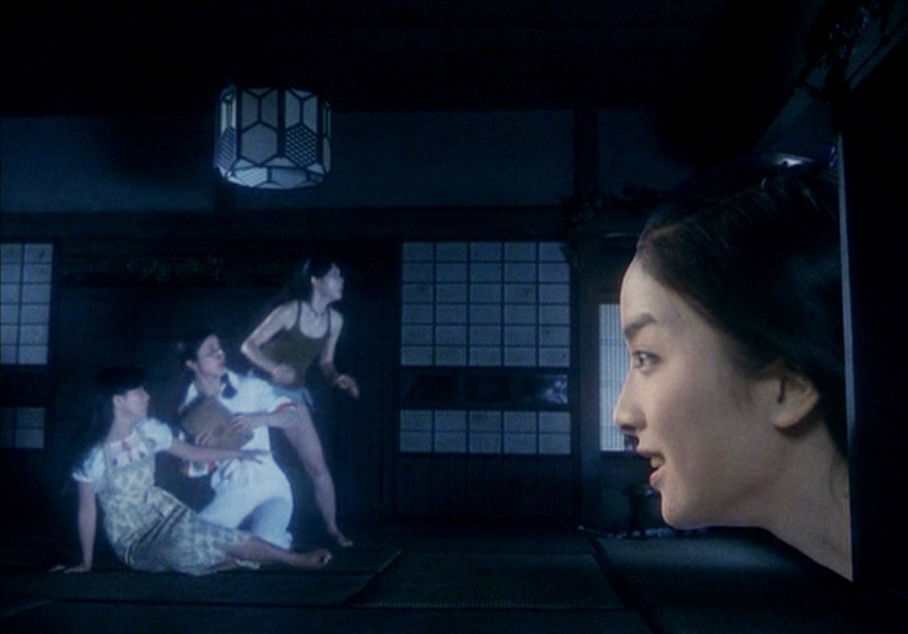
Although the recent Criterion release has allowed Obayashi's surreal exploration of teenage lift to gain new life, it still remains largely unknown by most. Outrageous, twisted, whacky... how to describe Houuuuuuse is virtually impossible, it simply must be seen to be believed. It may not be the Halloween film to keep you up at night with the lights on, but with a group of friends and some drinks you'll be sure to have a terrific night.


8. The Vanishing 
(Spoorloos)
 George Sluizer
1988

To call George Sluizer's 1988 European thriller a horror film may seem like a bit of a reach, but I'm indulging for a reason. It follows a mans obsessive three year search to discover the fate of his girlfriend who disappeared from a parking lot in the middle of the day. Her abductor is no ordinary psycho, a mild mannered family man and professor, The Vanishing is a slow, but engaging psychological thriller that does away with genre conventions to pose questions about the human condition; Does truth mean closure? And at what cost? Do we all harbor darker thoughts? However it is the films finale that lands it firmly on this list. To give away anything would be an injustice. For me, it is easily one of the most upsetting and unforgettable of images committed to celluloid. 


9. The Prophecy
Gregory Widen
1995

Big in scale, but short on budget Widen's tale of Angels, tortured 'priest detectives' and all out heavenly war is the stuff of total nonsense, but also the perfect Halloween treat. Christopher Walken delivers in spades as the angel Gabriel, perched on roof tops and sounding his trumpet (literally) to produce some giggles and Viggo Mortensen's appearance as Lucifer is all to brief but stays in the mind long after, for all the right reasons. It's not short on atmosphere either, with a tremendous sense of background scale, Prophecy earns it's cult following.


10. INLAND EMPIRE
David Lynch
2006

For many, Lynch's most recent feature is one of the most impenetrable movies ever made. A three hour long odyssey of surreal insanity; queue talking rabbits, creepy neighbours, Polish sex workers and of course the Locomotion. Starring Laura Dern, in one of this decades great performances, she is an actress who has just been cast as the star of a new remake of a cursed Polish film, or has she? Maybe she is just the product of an imagination of a girl who is hypnotized into believing she is someone else making a movie about herself...(?) You can understand the frustration of many. But for all it's twists, Lynch underscores his film with moments of absolute horror. Virtually indescribable, Lynch has an understanding of the individual's subconscious and peeling back the layers, he discovers the most disturbing of images. 

---------------------------------------------------------------------------------------------------------------------------

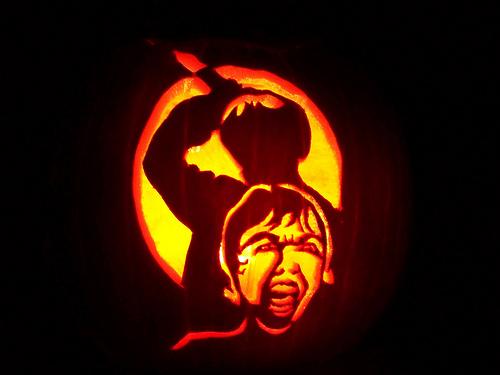
So there you have it, a briefly compiled list of some alternate titles to get you into the Halloween spirit. Have a good night folk, and I'll leave you with this to get your movie themed costumes rolling: